1099 vs W-2: The Contractor Classification Check to Run Before Year-End
The 1099-NEC threshold rose to $2,000 for 2026 payments — the definition of an employee did not move. Here is the contractor vs employee classification check to run on your books this fall.

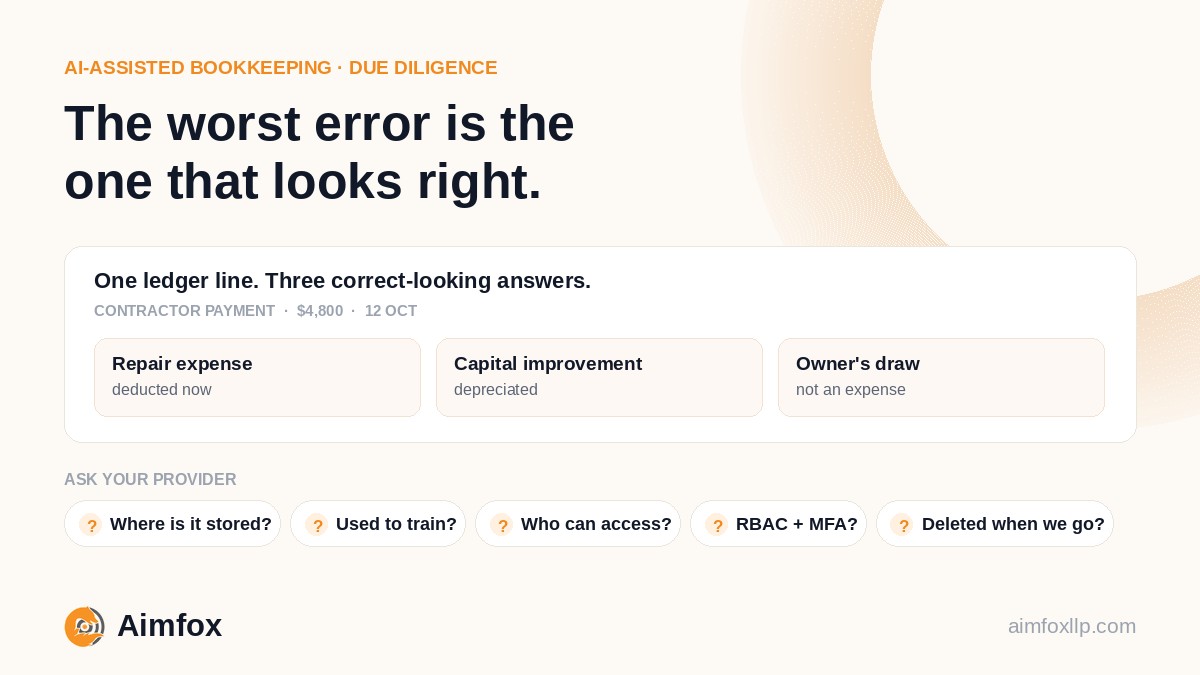
Most classification problems do not announce themselves. They show up quietly, in a ledger line that looks the same every month: a vendor paid the same amount, on the same day, for three years running, who has never invoiced anyone else.
On paper it is a contractor. In practice it may be an employee — and the difference is one audit letter wide.
Heading into the last quarter of 2026, the reporting rules around contractors changed while the classification rules did not. That gap is exactly where businesses get caught.
Why classification deserves a second look in 2026
Two things are true at once this year.
First, the Form 1099-NEC reporting threshold rose from $600 to $2,000 for payments made in 2026 — forms you will file in early 2027. Fewer forms will change hands.
Second, none of that touched the definition of an employee. The IRS test is the same test it was last year, and employment tax compliance remains one of its most active enforcement areas.
The practical effect is easy to miss: with fewer 1099s in circulation, the paper trail around your contractor spend gets thinner, and your general ledger becomes the primary evidence of how a worker was treated.
The states did not all follow
A federal simplification turns into a state mismatch quickly. Mississippi, Wisconsin and Massachusetts still expect reporting at $600. Missouri sits at $1,200. Arkansas uses $2,500 where no state income tax was withheld. California and Colorado have moved to $2,000.
If you pay contractors across state lines, the federal threshold is the floor of your problem, not the whole of it.
The three questions the IRS actually asks
There is no single deciding factor and no magic number of hours. The IRS looks at the whole relationship through three lenses — and your books hold evidence for all three.
Behavioral control
Does the business direct how the work gets done — set hours, assign a supervisor, provide training, require specific tools or procedures? The more you control the method rather than just the result, the more the relationship looks like employment.
Financial control
Who carries the business risk? Genuine contractors usually invest in their own equipment, can realise a profit or a loss, are free to work for others, and are paid by the project.
If you are reimbursing software seats, laptops and mileage, and paying a flat monthly amount regardless of output, that is a flag.
Relationship of the parties
Is there a written contract with a defined scope and end date, or an open-ended arrangement? Does the worker receive anything resembling benefits? Are they performing work that is core to what your business sells, rather than a discrete project alongside it?
What your books can flag before the IRS does
You do not need a legal opinion to spot the risky relationships. A bookkeeper with the vendor ledger open can surface most of them in an afternoon.
Look for identical recurring payments to the same individual across twelve or more months with no invoice variation. Contractor payments that look like salary — same amount, same date, every cycle. Reimbursements for equipment, software seats or mileage sitting in the contractor's vendor record. Anyone paid through both payroll and accounts payable in the same year. Missing or stale W-9s. And contractors whose payment volume makes them, effectively, a full-time person.
The simplest test we use. Print the twelve-month payment history for your top ten contractors by spend. If any of them would look like a payroll register to someone who did not know the labels, that relationship needs a proper review before year-end.
Why fixing it in Q4 is much cheaper than fixing it in Q2
The cost of getting this wrong is not one number. It is back payroll taxes, the employer's share of FICA, unemployment insurance, interest, penalties, and potentially unpaid overtime under wage-and-hour rules — plus benefits the worker should have been eligible for.
Fixing a classification in the fourth quarter means one clean transition, one W-2 for the stub period, and a story your CPA can explain. Fixing it in June means a split year for that worker, amended returns, and a much longer conversation.
There is also a straightforward practical reason to do it now: reclassifying somebody in December means their payroll setup is right on 1 January, rather than being retrofitted while W-2s are being prepared.
What to do about it
Start with the ledger review above, then take the genuinely ambiguous cases to your CPA or employment counsel — that is a legal determination, not a bookkeeping one.
Where a worker should be an employee, plan the transition for the start of a pay period, ideally at year-end. Where a worker is correctly classified, make the file support it: current W-9, a signed contract with defined scope, their own invoices, and no reimbursement pattern that undercuts the position.
And if the reason nobody has looked at this is that nobody has time to look at anything, that is the actual problem. Clean vendor records, current W-9s and a contractor ledger someone reviews monthly are ordinary back-office work — and they are what make this check a one-hour job instead of a project.
If your books are not current enough to run the review at all, catch-up bookkeeping comes first.
This article is general information, not tax or legal advice. Worker classification depends on the specific facts of each relationship, and state tests — California's ABC test among them — can be stricter than the federal one. Confirm your position with your CPA or employment counsel.