One governed data core
Most operators run on point-of-sale exports, spreadsheets, email attachments and half a dozen portals — none of which reconcile to each other. We build and run the system that replaces them: one database, one login, one permission model, feeding dashboards that open on what is wrong today rather than a report of what already happened.
What runs on it
Operations dashboard
The system of record
Performance dashboard
The number, before month end
One data core
One database · one identity · one permission model
open on what is wrong today
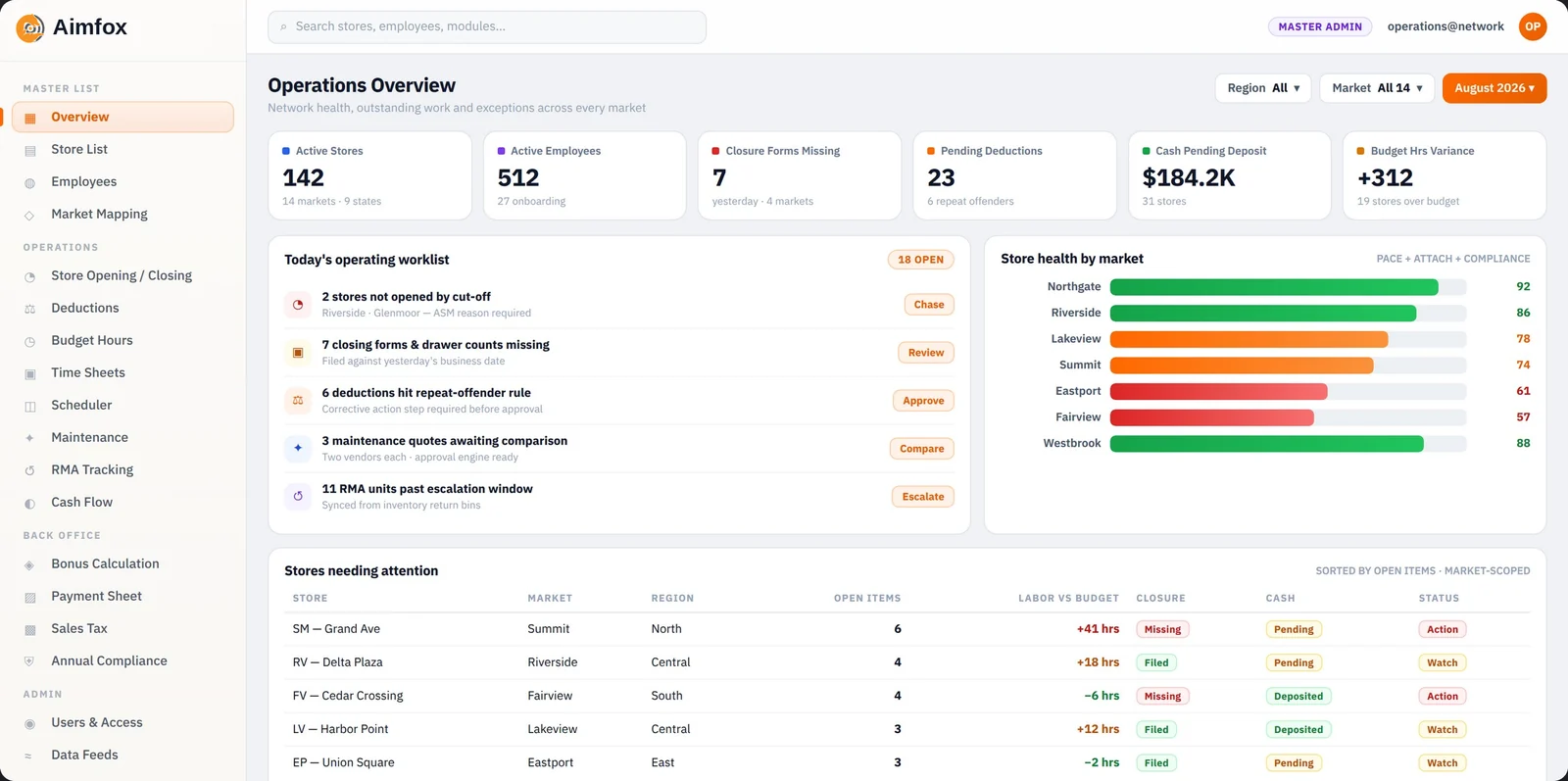

Shown with demonstration data — we don't publish live client screens.
Every site makes data. None of it agrees.
A multi-location operation runs on exports, spreadsheets and portals that were never designed to reconcile with each other. These are the four failures we see in every network before we start.
Data lives in silos
Sales sits in one export, inventory in another, labour in a third. Nothing shares a key, so joining them is a manual job somebody rebuilds every week.
The same join, rebuilt by hand, every week.
Reporting arrives late
By the time a number has been compiled, checked and circulated, the period it describes is over and the window to influence it has closed.
Decisions get made on last week's picture.
Nobody owns the exception
Problems surface in a meeting rather than being routed, the moment they appear, to the one person who can resolve them.
The fix waits for the next review call.
Access is all-or-nothing
Either a manager sees the entire company, or they get a static report they cannot filter, act on, or be measured against.
Sharing data turns into a risk conversation.
Two dashboards, one source of truth
Both applications read the same records through the same permission model, so a question asked in operations and a question asked in sales resolve against identical data.
Operations dashboard
The system of record
Runs the network: store and employee master data, daily readiness and compliance, labour, maintenance, incidents and the full back office.
- Store & employee master records
- Opening / closing compliance
- Scheduler, timesheets & budget hours
- Maintenance requests & vendor quotes
- Incidents, returns & escalations
- Cash flow, payment runs & journals
- Incentive calculation & statements
- Per-site P&L and compliance calendar
Used by Back office · Area managers · Ownership
Performance dashboard
The number, before month end
Runs the pace: month-to-date and intraday sales against goal, inventory ageing, purchase orders, loss prevention and field execution.
- Month-to-date sales against goal
- Pace to goal — projected close ÷ target
- Intraday movement, zero-selling sites flagged
- Leaderboards by site and person
- FIFO inventory ageing bands
- Purchase orders — ordered vs received
- Loss prevention & lost-unit ledger
- Category split and site comparison
Used by Managers · Market leads · Ownership
From raw feed to a decision someone owns
Data is never keyed by hand. It arrives on a schedule, is checked at the door, and only trusted rows reach a dashboard.
Connect
Automated feeds, hourly to monthlyThird-party APIs, secure file drops, managed uploads and in-product forms — collected on a schedule, never keyed by hand.
Validate
Failed rows are reported, not loadedRequired columns, row shape, header mapping and key values are checked before anything loads.
Unify
Joined on site, person and periodRecords are normalised — dates, money, quantities, IDs — then linked on shared business keys.
Compute
Pace, ageing, exception flagsBusiness rules turn records into pace, ageing bands, risk and exception signals.
Activate
Worklists, leaderboards, statementsRole-based dashboards, worklists, alerts and statements reach the person who owns the decision.
Idempotent loaders
Every loader upserts on a natural key, so a re-delivered or replayed file can never create a duplicate row.
Feed health is a screen
Staff see the last file received, the row count and the staleness of every feed — pipeline health is a product screen, not a private engineering concern.
Schema contracts
A file that fails its contract is rejected and reported, never silently loaded into a number someone then acts on.
Checked where it hurts
Feed loaders carry runnable self-checks against fixture rows, and calculations are re-verified against a reference before any change ships.
Where the intelligence sits
We are specific about this, because it is the question technical buyers ask. The platform is rules-driven where rules are the right answer, and applies pattern detection where a human would otherwise have to scan for it.
Projection, not just totals
Pace to goal projects month-end from run-rate and compares it to target, so "behind" is a number with days left to act on rather than a verdict after close.
Exception detection
Repeat-offender patterns, variances against expected ranges, ageing thresholds and zero-activity sites are surfaced automatically and routed to a named owner.
Assisted document handling
Invoice and statement capture reduces manual keying, with anything unmatched sent to a human queue rather than guessed at.
A human signs off
Nothing is published on model output alone. Maker-checker review sits in front of every figure that reaches a statement or a payment.
Right access. Real accountability.
Access is granted per page, not per bundle — and scope is enforced in the data layer, so hiding a menu item is never the security model.
Authenticated entry
Every session starts with an identified user. No open dashboard, no shared link.
Per-page access
Each module maps to a single access key, so any one screen can be granted or denied with no side effects on another.
Scope in the data layer
Site and market scope is enforced in the database — hiding a menu item is never the security model.
Roles, not bundles
Ownership, back office, market lead, area manager and field roles, with owner-only screens on an explicit allowlist.
Controlled writes
Administrative imports and workflow steps run their own permission checks before anything is written.
Traceable activity
An audit log of user actions and approvals is available in-product to administrators.
The platform, answered
No. In most builds the platform sits over what you already run — POS, accounting, payroll and carrier or vendor portals — pulling from them on a schedule and reconciling into one model. Replacing a system is a decision we'd only recommend if the current one is the actual constraint.
Both, depending on scope. There is a core we deploy and configure, and there are modules we build around how your business actually works. Either way our back-office team runs it day to day — you're not handed software and left to staff it.
It depends on how many feeds are involved and how clean the source data is. A single-module deployment on tidy data moves quickly; a multi-site build with a dozen feeds and historical clean-up takes longer. We scope it honestly before you commit.
Access is granted per page, and site or market scope is enforced in the database rather than the interface. An area manager sees their sites, ownership sees the network, and every write is permission-checked and logged.
It gets rejected and reported rather than loaded. Feed health — last file received, row count, staleness — is visible on screen, so a broken feed is noticed by staff that day instead of being discovered later inside a report.
Parts of it. Projections, exception detection and document capture use automation and pattern detection; the rest is deliberately rules-driven, because for compliance work an auditable rule beats a probabilistic guess. A human reviews anything that reaches a statement or a payment.
Want to see it against your own numbers? Read the case studies or book a walkthrough.
Leave the accounting to us
Your first month is free, onboarding takes as little as 24 hours, and rates start at $10/hour. No lock-in.