Automating the Month-End Close with AI: What to Hand Over, and What to Keep
Which parts of a month-end close can safely be automated with AI, which must stay with an accountant, and the guardrails that decide whether it works — for US and Canadian businesses and CPA firms.
It is the fifth of the month, the owner wants last month's numbers, and your team is still chasing uncategorised transactions.
A slow close is one of the most common frustrations we hear from businesses and CPA firms. Much of the repetitive work in it can now be automated — and it works best when an accountant stays firmly in charge.
This is about how to automate the close. If you are looking for the close itself, step by step, that is the month-end close checklist.
Why the close drags
Most delays are not caused by hard accounting. They come from volume and from waiting.
Hundreds of bank lines to categorise. Receipts that have not arrived. Reconciliations that will not tie out. Reviewers who only see the books once everything is "done".
Late closes mean late decisions. For CPA firms they also eat the time that was supposed to go to advisory work and tax prep.
Where automation actually helps
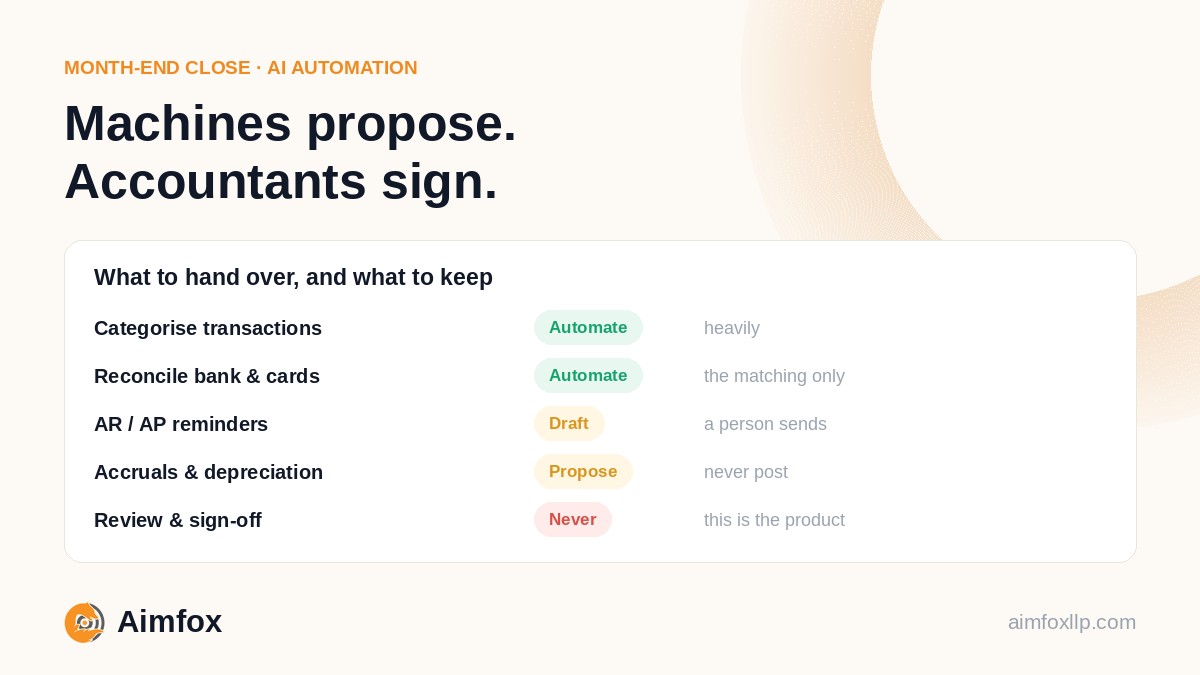
Categorising transactions — automate heavily
This is where the leverage is. Tools can apply vendor rules and learn from how a client has treated similar transactions before.
The thing that makes it safe is a confidence score. High-confidence matches move forward; anything unusual — a possible personal expense, a capital purchase — goes to a review queue rather than being posted silently.
Bank and card reconciliation — automate the matching, not the judgement
Matching can be automated by amount, date window and reference, leaving behind what actually needs a person: unmatched items, probable duplicates, stale uncleared cheques.
What it must never do is plug a difference. An accountant needs to understand why a balance is off, not watch it disappear.
AR and AP aging — automate the drafting, not the sending
Software can build the aging reports and draft the reminders — a friendly nudge at 30 days, a firmer note at 60. A person still decides what actually goes to a customer or a vendor.
Accruals, prepaids and depreciation — proposals only
AI can propose recurring entries with debit and credit lines and supporting notes. Treat them as proposals. Judgement on timing, materiality, and — in Canada — capital cost allowance belongs to the accountant.
If you have bought equipment this year, the fixed-asset records behind bonus depreciation are a good example of something a machine can prepare but should not decide.
Sales tax, GST/HST and payroll liabilities — automate the check, escalate the rule
Automated checks can compare tax liability accounts to filed returns and flag variances.
US sales tax and Canadian GST/HST, PST and QST rules differ by jurisdiction and change often. When a rule or a deadline is unclear it should be escalated to a CPA, not guessed. The same applies to economic nexus thresholds, which move every year.
Reasonableness and sign-off — never automate
Variance flags help — utilities up 40% versus last month tells a reviewer where to look first. But a named accountant reviews the P&L and balance sheet and approves the close package. That signature is the product.
The four guardrails
AI is a fast first-pass assistant, not a replacement for professional judgement. Before automating any part of a close, put these in place.
Human approval for anything that posts or sends. Journal entries, client messages and filings need a reviewer's sign-off — no exceptions, no "high confidence" bypass.
Every number traces to a source. If data is missing, the process says so rather than filling the gap. A plausible number with no provenance is worse than a blank.
Minimum necessary data. Mask account numbers and tax IDs, and only use tools your firm has actually vetted.
A real audit trail. Reviewers should be able to see what changed, why, and under which rule.
These are the same principles behind the platform we build and run: automated validated feeds, exceptions routed to a named owner, access scoped in the data layer, and a human sign-off before anything reaches a statement or a payment.
What it means for a CPA firm
A clean, consistent close is a capacity multiplier.
When an offshore team uses AI-assisted workflows to deliver reconciled monthly files in your software and your chart of accounts, your people start at review instead of cleanup. That frees hours for advisory work and busy-season preparation without adding fixed headcount.
It is the same argument as white-label bookkeeping generally — automation just changes where the hours go, not who is accountable for them.
Start small
You do not need to automate everything at once, and firms that try usually end up trusting none of it.
Pick the step that eats the most time — normally categorisation or reconciliation. Run it in parallel with your current process for a month or two and compare the results honestly. Expand only once the review queue is consistently clean.
If your books are too far behind to measure anything, catch-up bookkeeping comes first. Automation applied to messy books just produces wrong answers faster.
Want a faster, calmer close?
Aimfox has run remote bookkeeping for US and Canadian businesses and CPA firms since 2018 — in QuickBooks, Xero, Sage and more, with strict data-security practices and an accountant reviewing the work.
How we work · Ongoing bookkeeping · Dashboards, ERP & automation
This article is general information, not tax or accounting advice. Automation does not transfer professional responsibility — the reviewer who signs the close still owns it.