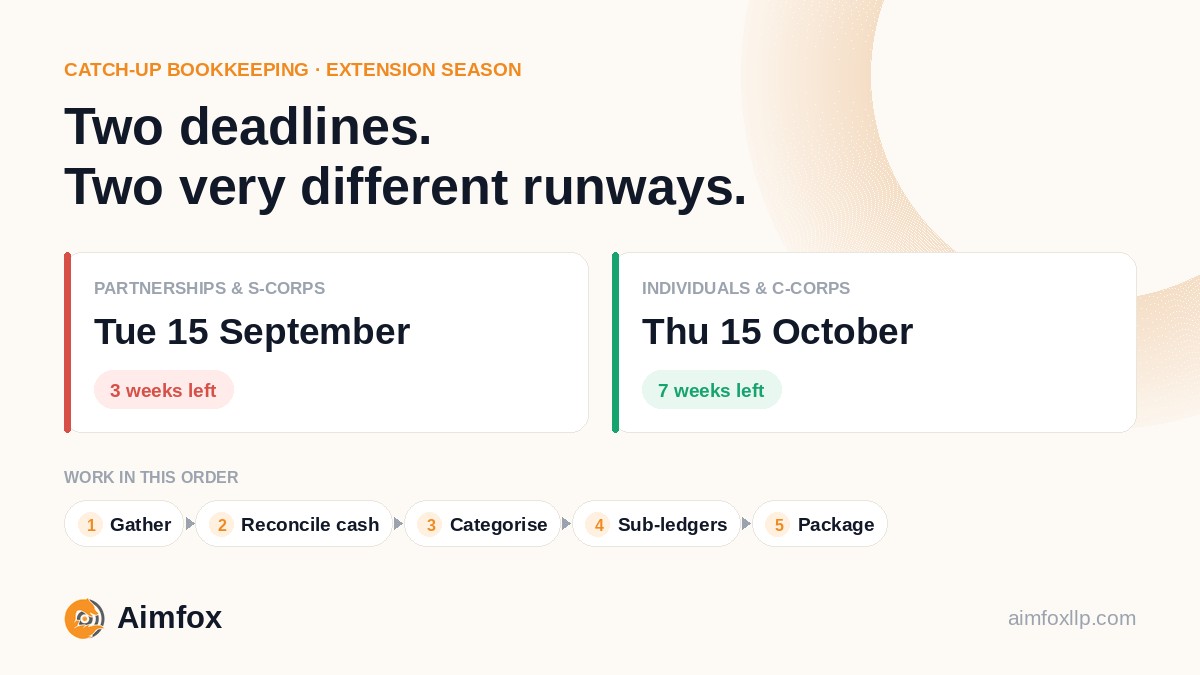
Your Year-End Bookkeeping Cleanup Checklist: Start in Q4, Not January
A seven-step year-end bookkeeping cleanup checklist for US and Canadian businesses and CPA firms — with the exact 2027 filing dates and a Q4 timeline you can actually follow.
Every January, the same story plays out. A business owner sends a shoebox of statements, a CPA discovers three unreconciled accounts, and what should be a two-week filing turns into a six-week scramble.
The fix is not working harder in February. It is starting the cleanup while there is still time to fix things — and Q4 is that window.
This is not a catch-up job. If your books stopped somewhere in the spring, you need catch-up and clean-up bookkeeping first, and this checklist afterwards. This is the list for books that are broadly current and need to be closed properly.
Why Q4 and not January
Cleanup is cheaper and faster when memories are fresh. A mystery $4,200 deposit in October is a quick email to a client. In March it is a guessing game, and the answer is usually "book it and move on" — which is how bad numbers get locked into a filed return.
Starting early also buys you decisions. Clean numbers in November mean your CPA can do actual tax planning while there are still moves available before 31 December: timing an equipment purchase, reviewing estimated payments, deciding whether to defer an invoice. Clean numbers in March mean your CPA can only report what already happened.
The checklist
1. Reconcile every account
Bank accounts, credit cards, loans, merchant processors and payroll clearing accounts should all tie to their statements through the last day of the year.
Do not forget dormant accounts and payment platforms — Stripe, PayPal, Square. Gross deposits go in, processor fees never come out, and you end up paying tax on revenue you never received.
2. Clear uncategorised and suspense items
Sweep out "Uncategorized Income", "Ask My Accountant" and any suspense balances. Each one is a question your CPA will otherwise have to ask, and each one distorts your profit figure while it sits there.
3. Review receivables and payables
Age your receivables and decide what is genuinely collectible. Confirm that vendor bills belonging to this year are recorded in this year.
Stale and duplicate entries quietly overstate both income and liabilities — and an AR balance full of invoices that were settled in cash is one of the clearest signs a P&L is wrong even when it looks plausible.
4. Get 1099 and W-2 information in order
This is the step with hard dates attached, so here they are precisely.
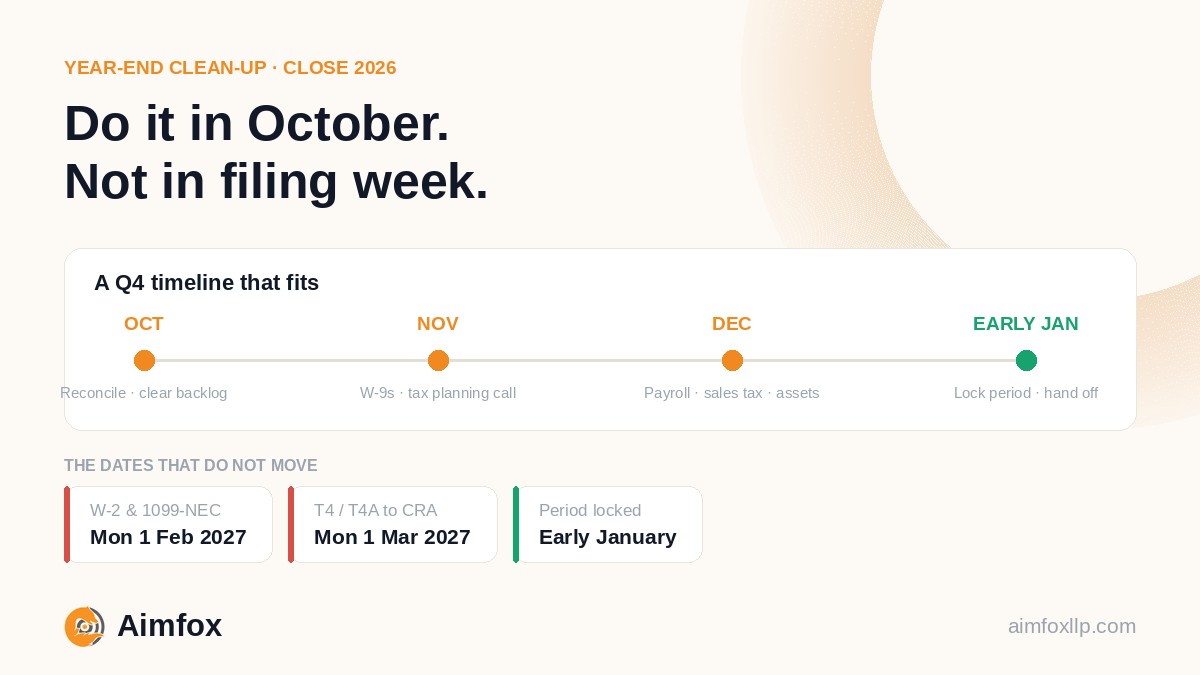
For the 2026 tax year, Forms W-2 and 1099-NEC are due Monday 1 February 2027 — the usual 31 January deadline falls on a Sunday, so it rolls to the next business day. That applies both to filing with the SSA or IRS and to getting copies to the recipient.
In Canada, T4 and T4A slips follow the last-day-of-February rule. That day is a Sunday in 2027, so the CRA filing moves to Monday 1 March 2027 — but plan on having employee copies in hand by Friday 26 February, because the "last day of February" wording for employee copies leaves you no comfortable margin.
Collect W-9s from contractors now, confirm legal names and tax IDs against them, and verify which payments are actually reportable. Note that the 1099-NEC threshold rose to $2,000 for 2026 payments, and several states did not follow — so fewer federal forms does not mean fewer state forms.
While you are in the vendor ledger, it is the natural moment to run the contractor vs employee check. Reclassifying somebody in December is one clean transition; reclassifying them in June is a split year and amended returns.
5. Tidy fixed assets and inventory
Record purchases made this year, remove items sold or scrapped, and match inventory counts to the books. These entries drive depreciation and cost of goods sold, two areas where small errors turn into large tax differences.
With 100% bonus depreciation now permanent, the fixed-asset register carries more weight than it used to — you need the acquisition date and the placed-in-service date recorded separately, not just an invoice.
6. Reconcile payroll and sales tax
Compare payroll reports to the general ledger and confirm every remittance was filed and paid.
For US sales tax, or GST/HST and provincial taxes in Canada, make sure collected balances match what was actually reported. If you sell across state lines, this is also when you confirm you have not crossed an economic nexus threshold during the Q4 rush.
7. Lock the period and package the handoff
Once the year is reconciled, close the period so nobody can accidentally post into it.
Then assemble the handoff: financial statements, reconciliation reports, a fixed-asset list, loan statements, and short notes on anything unusual. Your CPA does not want a login — they want a package they can start work from.
A Q4 timeline that actually fits
You do not need to do all of this at once.
October — reconcile through September and clear the backlog of uncategorised items. This is the heaviest month; everything after it is lighter.
November — chase contractor W-9s, review receivables, and book the tax-planning call with your CPA while there is still time to act on what they say.
December — finish payroll and sales tax reviews, gather fixed-asset changes, and make any timing decisions before the 31st.
Early January — reconcile the final month, lock the period, send the package. Then the 1 February deadline is a formality rather than a fire drill.
The mistakes that cost the most
Three come up again and again: personal and business spending mixed in the same account, the final month's reconciliation skipped because the year "looks done", and contractor paperwork left until filing week.
None of them are hard to fix in Q4. All of them are expensive in January.
Where an outsourced team helps
Year-end cleanup is a crunch for in-house teams, and for CPA firms it lands directly on top of tax season.
An outsourced bookkeeping team can reconcile, categorise and package the books in parallel with your own work, without hiring seasonal staff. For firms, a dependable back office means clients arrive with clean files and your people spend the season on review and advisory rather than data repair — which is the whole argument for planning your busy-season capacity now.
And once the year closes clean, the way to stay that way is a monthly close rather than an annual reckoning.
Ready to close 2026 cleanly?
Aimfox helps US and Canadian businesses and CPA firms close the year on time with books that are accurate, organised and ready to file. Not sure how messy yours are? A short call is usually enough to find out.
Year-end clean-up · Ongoing bookkeeping · White-label support for CPA firms
This article is general information, not tax advice. Filing dates shift for weekends and holidays and differ for fiscal-year filers — confirm the dates that apply to you with your CPA.