100% Bonus Depreciation Is Permanent — Can Your Fixed Asset Records Prove It?
100% bonus depreciation is permanent again. See the fixed asset register, placed-in-service documentation and state schedules your books need before year-end 2026.
Most business owners heard the headline: 100% bonus depreciation is back, and this time it is permanent. Buy the truck, buy the equipment, write the whole thing off in year one.
What almost nobody heard is the quieter half of the story. The deduction lives or dies in your fixed asset records, and most sets of books were never built to carry that weight.
We see it every spring. A client forwards a stack of equipment invoices in March, their CPA asks when each asset was actually placed in service, and nobody can answer. The deduction does not disappear — but the scramble is expensive and entirely avoidable. Here is what changed, and what to fix in your books between now and December.
What changed, and the date that decides everything
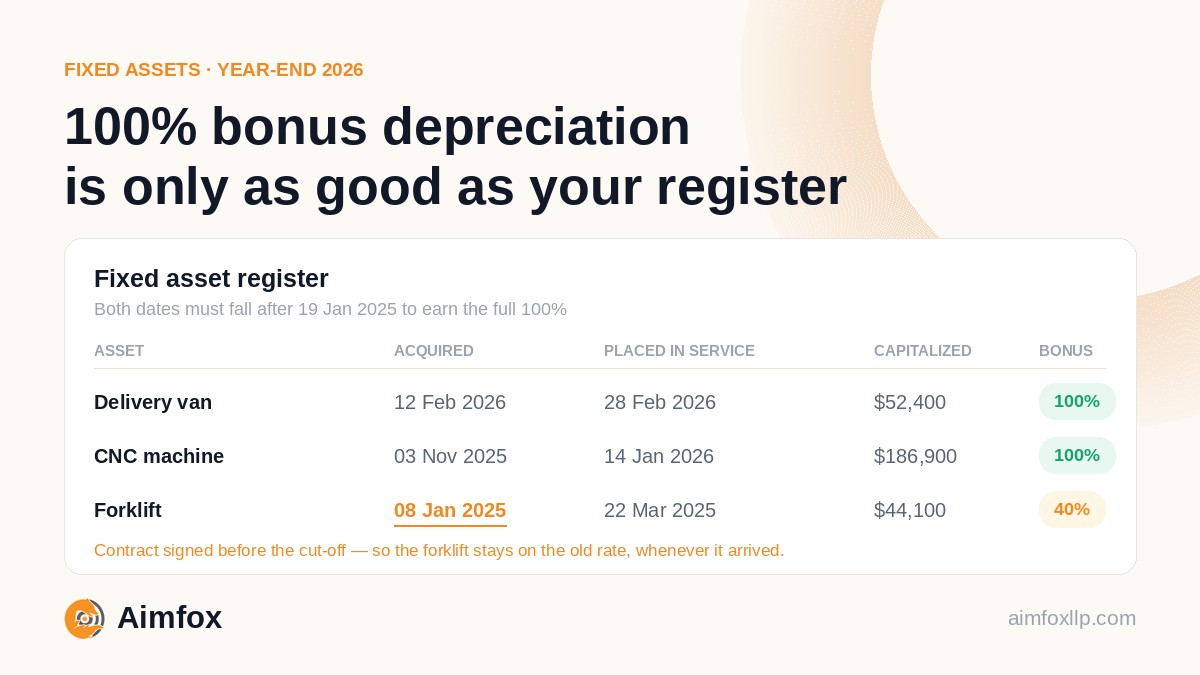
Under the One Big Beautiful Bill Act, 100% bonus depreciation was restored for qualified property acquired and placed in service after January 19, 2025, with no scheduled phase-down. The old step-down ladder — 60%, 40%, 20% — is gone for anything on the right side of that date.
That cutoff is not a formality. Property acquired under a written binding contract entered into before January 20, 2025 is treated as acquired on the contract date, which can knock otherwise-eligible property off the 100% rate even if it did not arrive until much later.
IRS Notice 2026-11, issued in January 2026, is explicit about this: both dates have to clear the cutoff. The acquisition date, meaning when the contract became binding, and the placed-in-service date, meaning when the asset was ready and available for use.
So your books now need two dates per asset that many registers never recorded separately. When you committed to buy it, and when you could actually use it.
Section 179 still goes first
Bonus depreciation did not replace Section 179. For tax years beginning in 2026 the Section 179 cap is $2,560,000, phasing out dollar-for-dollar above $4,090,000 of qualifying property placed in service, with full phase-out at $6,650,000.
The stacking order is unchanged. Section 179 applies first, bonus depreciation takes the remaining basis, then regular MACRS handles whatever is left. The two are complements, not alternatives — and both are only as good as the schedule underneath them.
The three records that make or break the deduction
Good record keeping here is not complicated. It is just disciplined, and it has to happen while the paperwork still exists.
1. Placed-in-service evidence, not just an invoice date
The IRS cares when an asset was ready and available for its intended use, not when you paid for it. Delivery receipts, installation sign-offs, operational testing records and contemporaneous internal notes are all fair game.
A machine that landed on your dock on December 27 but was not commissioned until January belongs in next year. This is the single most common gap we find in a clean-up engagement.
2. Fully capitalized cost, not the number on the bill
Cost basis includes purchase price plus sales tax, freight, delivery and installation. Those charges routinely land in three different expense accounts on three different dates, then never make it back to the asset.
Every dollar you fail to capitalize is a dollar of first-year deduction you quietly gave away.
3. Business-use percentage, tracked as you go
Vehicles and mixed-use equipment need substantiated business use. Reconstructing a mileage log in April is painful, unconvincing, and exactly what an examiner looks for first.
A five-minute test for your fixed asset register. Pick any asset added this year. Can you produce, right now, the acquisition date, the placed-in-service date, the fully capitalized cost with supporting documents, and the business-use percentage? If not, that is your December project.
Multi-state? You are now keeping more than one schedule
This is where the real bookkeeping burden sits. A long list of states has not conformed to federal bonus depreciation — California, New York, New Jersey, Massachusetts, Pennsylvania, Connecticut, Maryland, North Carolina, Indiana and Wisconsin among them — and they require an add-back, with the asset recovered over its normal life on the state return.
California, for instance, requires a full add-back of federal bonus depreciation. You take a large federal deduction and get little or nothing immediately at state level. New York allows its own smaller first-year deduction in place of the federal one.
If you operate across state lines, that means maintaining a separate depreciation schedule per non-conforming state, each with its own adjustment. Conformity rules also change from year to year, sometimes retroactively.
Two schedules is a spreadsheet problem. Six is a process problem.
Four fixes to make before December
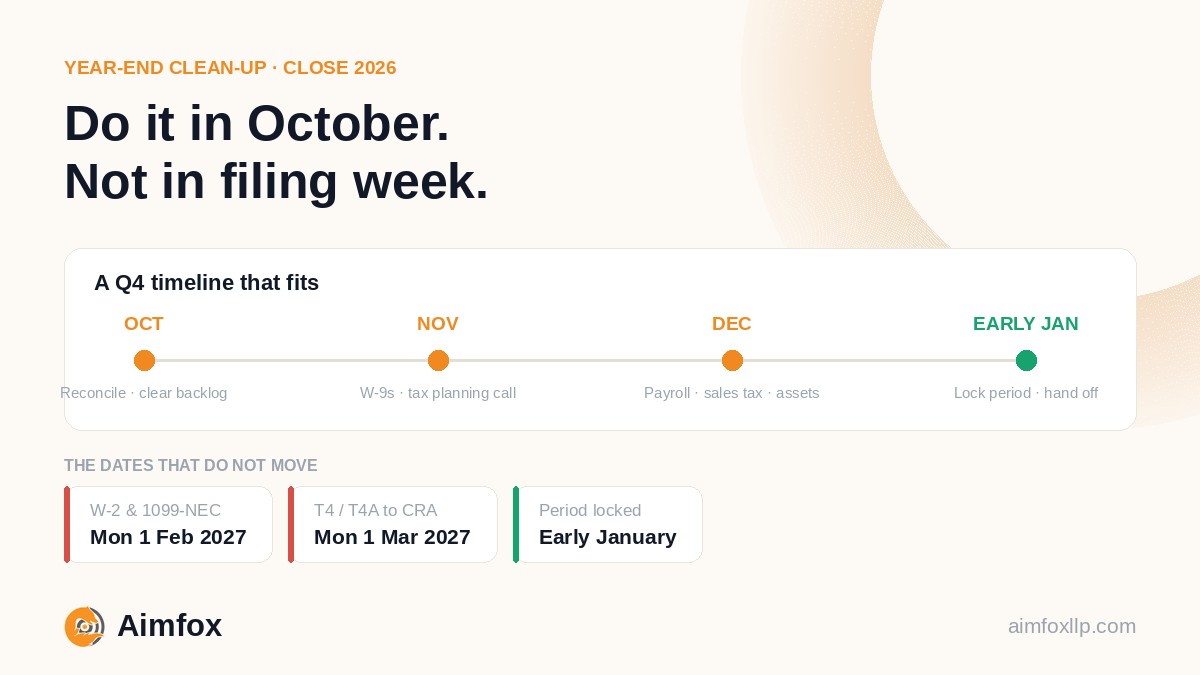
None of these require new software. They require someone to actually do them before the year closes.
Open the fixed asset register and add two columns. Acquisition or contract date, and placed-in-service date. Backfill everything added since January 2025 while the emails and delivery notes are still findable.
Sweep your expense accounts for miscoded capital items. Freight, installation labour and setup fees hiding in repairs or supplies belong on the asset. This is a natural addition to your month-end close checklist rather than a once-a-year hunt.
Build a documentation folder per asset. Invoice, delivery receipt, installation confirmation, in one place. You may need it years from now.
Confirm your state schedules with your CPA now, not in March. Ask which states require an add-back and get the parallel schedules started before filing season swallows everyone.
The deduction is only as good as the books behind it
Permanent 100% expensing is a real cash-flow advantage, and for capital-intensive businesses — construction and trades, transportation, manufacturing — it is a large one.
But it rewards companies whose records are already in order, and it punishes the ones reconstructing history under deadline. The work is small if it happens monthly and brutal if it happens once a year.
If your fixed asset register is a tab in a spreadsheet nobody has opened since spring, that is a fixable problem. And a good reason to fix it before Q4.
This article is general information, not tax advice. Federal and state depreciation rules change, sometimes retroactively — confirm treatment for your situation with your CPA before filing.