Q3 Estimated Tax Payments Are Due September 15: What Your Books Need to Get Them Right
Q3 estimated tax payments are due September 15, 2026. See what US and Canadian businesses should fix in their books before the quarterly deadline — and the safe harbor if they can't.
Most business owners think of tax season as a January-to-April event. The books disagree.
Four times a year, the IRS and the CRA expect a payment based on what your business has actually earned so far — and the next one lands on Tuesday 15 September 2026. Miss it, or underpay it, and the cost is not a flat fee you can shrug off. It is interest, running daily, on money you were supposed to have already sent.
The uncomfortable part is that most businesses guess. They take last quarter's number, add a bit, and hope. That works right up until it doesn't — usually in a year when revenue moved, a big client paid late, or a piece of equipment got expensed.
Getting Q3 right is not really a tax problem. It is a bookkeeping problem, and it is solvable in a week.
What is actually due on September 15
United States
September 15 is the third-quarter due date for federal estimated tax on Form 1040-ES, covering income earned from 1 June through 31 August. It applies to sole proprietors, partners, S-corporation shareholders, and anyone whose income is not fully covered by withholding.
As a general rule you owe estimated payments if you expect to be short by $1,000 or more after withholding and refundable credits. Many states run their own quarterly schedule alongside the federal one, so check your state's calendar rather than assuming it mirrors the IRS.
Canada
The date is the same, which is convenient for cross-border owners. Individual CRA instalments in 2026 fall on 15 March, 15 June, 15 September and 15 December.
You are generally in the instalment system if your net tax owing tops $3,000 ($1,800 in Quebec) in the current year and exceeded it in either of the two prior years. Most corporations remit monthly, though Canadian-controlled private corporations with a clean compliance record, taxable income under $500,000 and taxable capital under $10 million can often move to quarterly.
Why guessing costs more this year
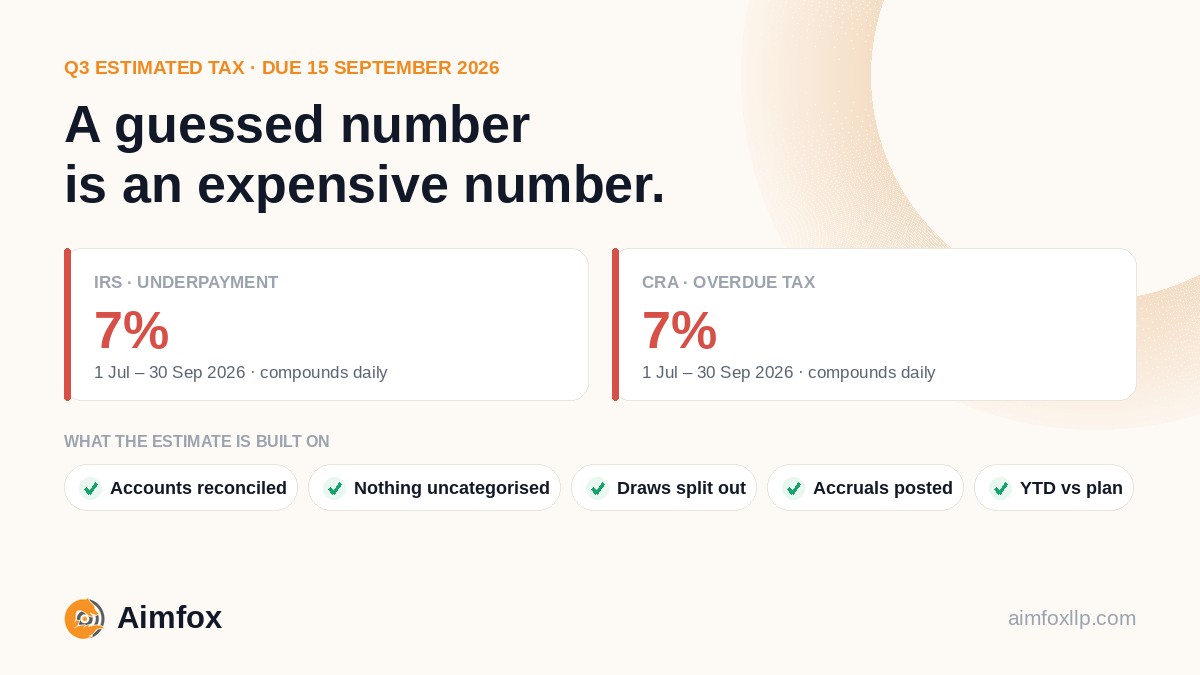
For the quarter running 1 July to 30 September 2026, the IRS underpayment rate for individuals is 7%, compounding daily. On the Canadian side, the CRA's rate on overdue tax for the same quarter is also 7%, likewise compounded daily, with a further penalty possible once instalment interest gets large enough.
Both rates are reset every quarter, so confirm the current figure before you rely on it — but the direction of travel is the point. This is meaningfully higher than the rate most owners internalised during the low-rate years, and it applies from the day the payment was due, not from the day you file.
The practical translation: an underpayment carried from mid-September to next April is borrowing at a rate you would never accept from a lender. Unlike a loan, there is no upside. You were always going to owe it.
Five bookkeeping fixes to make before the deadline
None of this needs a tax specialist. It needs books that are current through 31 August, and a short review with fresh eyes.
1. Reconcile every account through August
Bank, credit card, merchant processor and loan accounts. An unreconciled processor account is the single most common reason a service business overstates income — gross deposits go in, fees never come out, and you end up paying tax on revenue you never actually received.
2. Clear the uncategorised bucket
Every transaction sitting in "Ask My Accountant" or an uncategorised holding account is a number your estimate is missing. Deductions parked there quietly inflate both your taxable income and your payment.
3. Separate owner draws from expenses
Draws are not deductible; they are equity movements. Coded as expenses, profit looks lower than it is and the estimate comes in short — which is the version of this mistake that costs interest rather than cash flow.
4. Post the accruals a cash view hides
Unbilled work, prepaid insurance, depreciation and inventory adjustments all shift the profit figure your estimate is built on. If you report on an accrual basis, running the estimate off an unadjusted cash P&L produces a number that is wrong in a direction you cannot predict.
If you have bought equipment this year, the fixed-asset and bonus depreciation work belongs in this step too — full expensing can move a quarterly estimate substantially.
5. Compare year-to-date profit against your April assumption
This is the step almost everyone skips. Pull the January–August P&L and set it beside the projection your April payment was based on.
If profit is running 20% ahead, your first two payments were light and Q3 has to absorb the gap. If it is running behind, you may be sitting on an overpayment worth reclaiming through a smaller September cheque.
Short on time before September 15? US filers can generally fall back on a safe harbor: pay 90% of this year's tax, or 100% of last year's total tax — 110% if your prior-year AGI was above $150,000 — and you are protected from underpayment penalties regardless of how the year turns out. It is a floor, not a plan, and it can mean overpaying if this year is slower. But it buys a clean quarter while the books catch up.
The other thing due on September 15
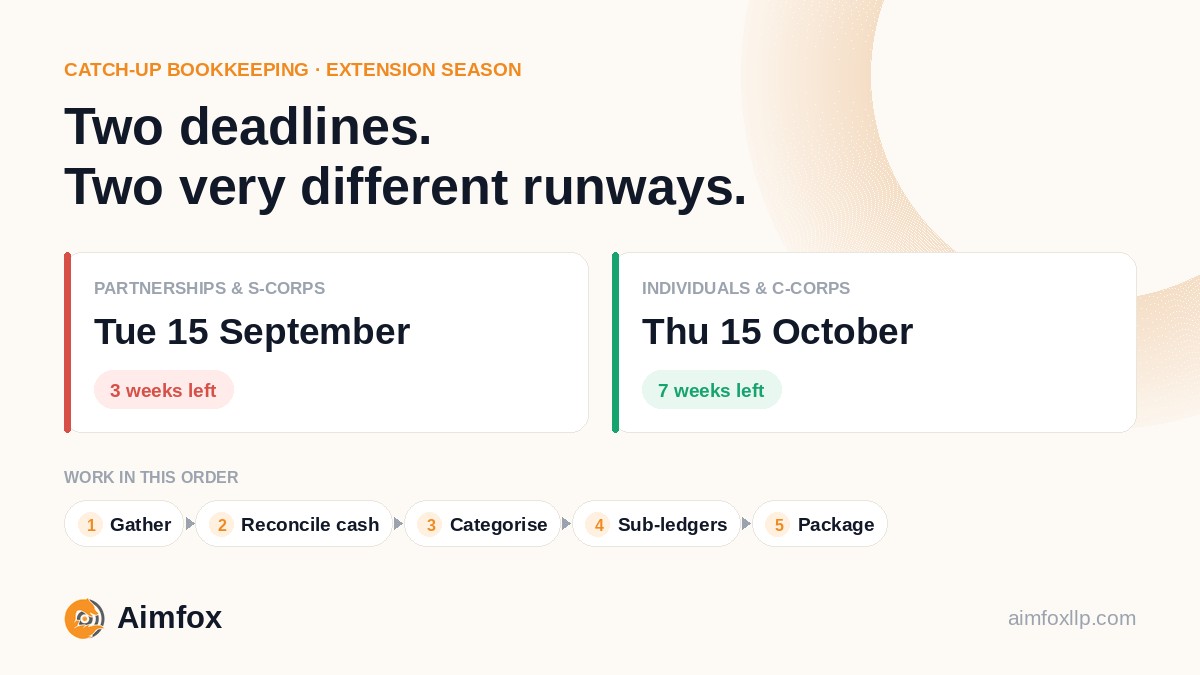
If you filed an extension, note that the same date is the extended deadline for partnership and S-corporation returns. Plenty of businesses owe an estimated payment and a return in the same week.
If your books are not current enough to do either, start the catch-up now rather than in September — the reconciliation work feeds both jobs, so it is one effort, not two.
Turn the scramble into a rhythm
The businesses that never sweat a quarterly deadline are not better at tax. They are better at closing their books.
When the month-end close finishes by the tenth, the estimated payment becomes a fifteen-minute calculation off numbers you already trust, and 15 December arrives without drama.
That is also the difference between an estimate and a decision. Current books tell you whether to accelerate an equipment purchase, whether to defer an invoice, whether the quarter can absorb a hire. Books three months behind tell you nothing except roughly how much you probably owe.
If your August close is not done, the honest move is to start it today rather than on 14 September. And if the close keeps slipping because there is simply nobody to do it, that is a capacity problem worth solving before Q4 — when year-end, 1099s and T4s all queue up behind it.
Get your books deadline-ready
Aimfox runs the day-to-day books for businesses and CPA firms across the US and Canada — reconciliations, accruals and month-end close, plus the reporting that turns quarterly estimates into a calculation instead of a guess. GAAP-ready, in your time zone, with a dedicated team and a reviewer on top.
Behind on more than a month? Catch-up and clean-up bookkeeping gets you current first. First month free, onboarding inside 24 hours, rates from $10/hour.
This article is general information, not tax advice. Deadlines, thresholds and interest rates change quarterly, and your situation may differ — confirm the specifics with your CPA or tax advisor before you pay. Current rates are published by the IRS and the CRA.