Protect the margin on every fuel and shelf sale
Fuel and convenience retail runs on volume and razor-thin margins, which makes the back office unforgiving. A missed price update, an unrecorded fuel invoice, or a register that never got reconciled can quietly cost a site thousands a month. We run the daily back office so your numbers stay audit-ready without adding headcount.
What makes gas stations & convenience stores books different
These are the places we see go wrong most often — and the first things we fix.
Margins erode silently
A pricing update that never got made, or a cost increase nobody caught, doesn't announce itself — it just quietly shrinks the margin on every gallon and every shelf sale until someone checks.
One person records and approves
In a single-site operation the same employee often enters the transaction and signs it off. That's where missing cash, duplicate vendor payments, and coding errors hide.
Daily volume, delayed reconciliation
Fuel, non-fuel, lottery, and card settlement all move daily. Left to month end, variances are impossible to trace back to the shift or invoice that caused them.
Built for how you actually operate
- Fuel, non-fuel & lottery invoice recording
- Margin verification against target, with pricing updates
- Daily closing balances matched to your ERP
- Variance investigation traced to root cause
- Register, POS & back-office sales reconciliation
- Vendor and store payment processing
- Accounting software kept current — entries, ledgers, reconciliations
- Daily cash position per site and deposit tracking
- Per-site P&L with multi-site consolidation
- Maker-checker review on every store entry
Software we work in
- QuickBooks
- Xero
- POS & register systems
- Fuel ERP systems
- Bill.com
Using something else? We adapt to your stack — just ask.
Flexible pricing
from $10/hour
- Hourly, dedicated, or fixed monthly
- Free first-month trial
- Onboarding in 24 hours
The daily back-office cycle
Your store employee handles the daily inputs. Everything after that runs on our side, with an independent review before anything is finalised — so you get more consistent oversight than one in-store employee can provide, at a fraction of a full-time hire.
Invoice & transaction recording
Back officeEvery fuel, non-fuel, and lottery invoice logged accurately and on time.
Margin verification & pricing
Back officeMargins checked against target, pricing updated, and store staff notified of changes.
Daily closing & ERP verification
ClientClosing balances entered and matched against the ERP system every day.
Variance investigation
Back officeAsset and liability variances traced to root cause and resolved, not carried forward.
Sales reconciliation
Back officeRegister, POS, and back-office sales reconciled so reported revenue checks out.
Payment processing
Back officeVendor and store payments prepared accurately and on schedule.
Accounting & bookkeeping
Back officeYour accounting software kept current — entries, ledgers, and reconciliations.
Data controls
- Maker-checker — the person who records is never the person who approves
- Every store entry independently reviewed before it is finalised
- Daily closing matched to ERP, so variances surface within 24 hours
- Pricing checked against target margin, with store staff notified
- Role-based access and full audit logs on every change
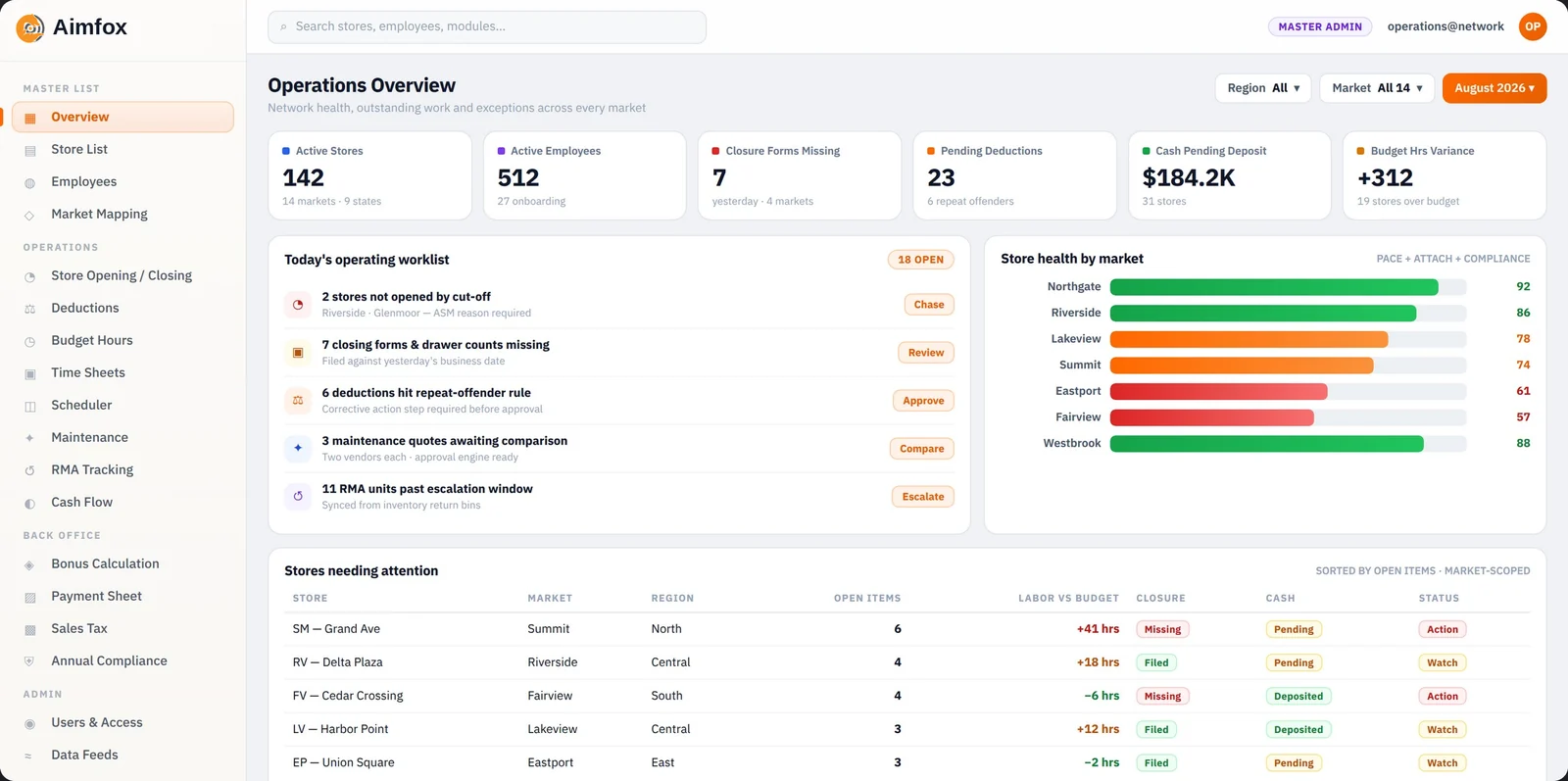
The dashboard behind it
This workflow doesn't run on email and spreadsheets
Every stage above is a state in a system we built and operate — data pulled and validated on a schedule, exceptions routed to a named owner, and access scoped so each person sees only their own portfolio. Nothing reaches a statement or a payment without a human sign-off.
- Automated, validated feedsLoaders re-run safely; a failed feed shows as a red row, not silence.
- Exceptions have an ownerAnything that breaks a rule lands on a named person's queue with a due date.
- Access scoped in the data layerPermissions are enforced where the query runs, not just hidden in the UI.
Where we usually start
Gas Stations & Convenience Stores, answered
No — that's the point of the model. Your existing store employee handles the daily inputs; we handle recording, verification, reconciliation, and the books. You get more consistent oversight than one in-store person can provide, for a fraction of a full-time hire's cost.
It separates the person who records a transaction from the person who approves it. In single-site retail those are usually the same employee, which is exactly how missing cash, duplicate vendor payments, and miscoding go unnoticed. We act as the independent checker on every store entry.
Yes. We work from your POS, register, and ERP reports and reconcile them to the accounting ledger — we don't require you to change systems. Tell us what you run and we'll confirm the reporting we need.
Yes. Multi-site operators get per-site reporting plus a consolidated view, so locations can be compared on the same basis and an underperforming site is obvious early rather than at year end.
Yes — daily cash position per site, deposits banked versus expected, and any gap flagged the same day rather than surfacing at month end. Payment runs to vendors are prepared on the same cycle.
Yes. Each location gets its own profit and loss on consistent definitions, plus a consolidated group view — so you can see which sites carry the network and which need attention.
Other industries we know well
Leave the accounting to us
Your first month is free, onboarding takes as little as 24 hours, and rates start at $10/hour. No lock-in.