Fill vacancies faster, run leaner doing it
Every vacant day and every extra on-ground hire cuts into owner returns. We list units across every major platform the day they go vacant, keep showings and applications moving, and run the books behind it — so a small front-line presence is all you actually need.
What makes real estate & property management books different
These are the places we see go wrong most often — and the first things we fix.
Vacant days compound quietly
A unit that sits three extra weeks because the listing went up late or a showing never got booked is lost rent you can never recover.
On-ground headcount is expensive
Leasing coordinators, admin staff, and bookkeepers add fixed cost per door. Most of that work doesn't need to be physically on site.
Trust funds and owner money
Security deposits and owner funds must never commingle with operating cash — and every rent payment needs an independent check before it's final.
Built for how you actually operate
- Same-day listings across Zillow, Apartments.com, Avail & Facebook
- Showing scheduling and prospect follow-up
- Tenant application screening and verification
- Lease preparation and first-payment verification
- Rent collection tracked against every lease
- Trust and escrow reconciliation, kept segregated
- Maintenance request routing through to resolution
- Vendor invoice processing and payment runs
- Monthly owner statements and per-property P&L
Software we work in
- Buildium
- AppFolio
- Yardi
- RentManager
- Zillow
- Apartments.com
- Avail
- QuickBooks
- Xero
Using something else? We adapt to your stack — just ask.
Flexible pricing
from $10/hour
- Hourly, dedicated, or fixed monthly
- Free first-month trial
- Onboarding in 24 hours
From vacant unit to active lease
Leasing is a pipeline, and vacant days are what it costs when a stage stalls. We run every unit through the same tracked stages, with a named owner on each step — so nothing sits waiting for someone to remember it.
Unit goes vacant
Back officeFlagged the day it becomes available; anything sitting over 24 hours without a listing is escalated.
Listed across platforms
Back officePosted same-day to Zillow, Apartments.com, Avail and Facebook for maximum reach.
Showings booked
Back officeEnquiries answered and showings scheduled quickly, so interested prospects don't go cold.
Showing conducted
ClientYour on-ground agent shows the unit; outcome and interest level recorded same day.
Application & screening
Back officeApplications screened and verified fast, keeping qualified tenants moving forward.
Lease prepared
Back officeLease generated from the approved application data, ready for signature.
Signed & first payment
ClientSignature and first rent payment verified before keys are released.
Keys handed over — active
Back officeUnit moves to active tenancy and into the monthly rent and reporting cycle.
Data controls
- Maker-checker — every rent payment and ledger entry independently reviewed
- Trust and escrow funds reconciled separately from operating cash
- Units vacant beyond 24 hours trigger an escalation
- Expiring leases flagged at 90, 60 and 30 days for renewal outreach
- Full audit trail on every status change and approval
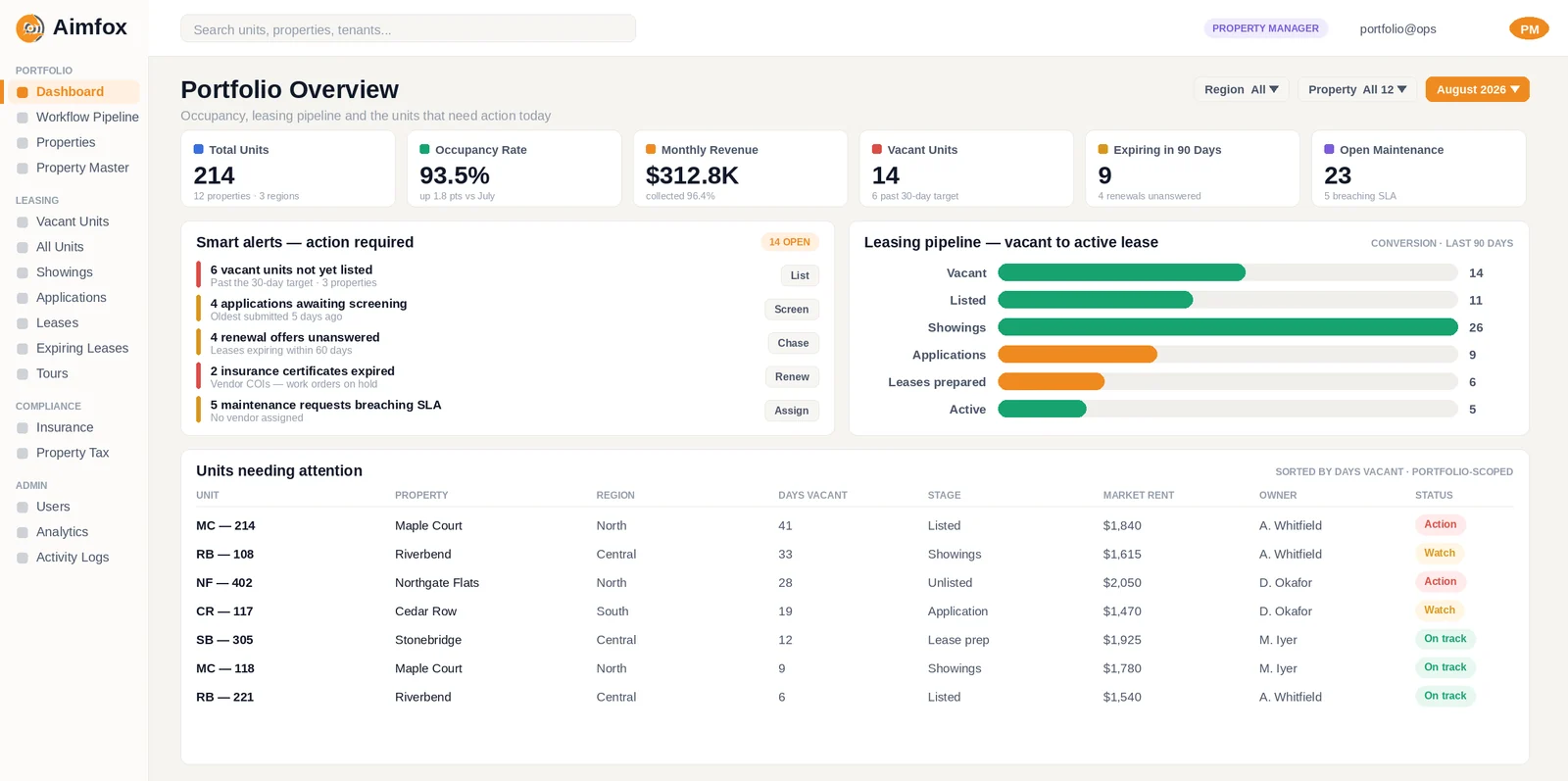
The dashboard behind it
This workflow doesn't run on email and spreadsheets
Every stage above is a state in a system we built and operate — data pulled and validated on a schedule, exceptions routed to a named owner, and access scoped so each person sees only their own portfolio. Nothing reaches a statement or a payment without a human sign-off.
- Automated, validated feedsLoaders re-run safely; a failed feed shows as a red row, not silence.
- Exceptions have an ownerAnything that breaks a rule lands on a named person's queue with a due date.
- Access scoped in the data layerPermissions are enforced where the query runs, not just hidden in the UI.
Where we usually start
Real Estate & Property Management, answered
A small one. Someone local still shows units and handles physical access — but listing, scheduling, screening, lease prep, rent tracking, maintenance coordination, and the books all run from our side. That's how operators keep a lean front line without losing control.
Zillow, Apartments.com, Avail, and Facebook Marketplace as standard, plus whatever else your market responds to. Listings go up the same day a unit is flagged vacant — wider reach and a faster start are what shorten vacancy.
Yes. Trust and escrow funds are reconciled separately from operating accounts, with their own ledgers and monthly reconciliation, so deposits and owner funds are never commingled.
Yes — monthly owner statements with distributions, per-property income and expense detail, and supporting documentation, formatted the way your owners expect.
Yes. We track occupancy by property, days vacant, showing-to-lease conversion, average days to lease, and expiring leases at 90/60/30 days — so you can see which properties and which stages are costing you rent.
No. We handle multi-state portfolios routinely and track the reporting each jurisdiction requires. Confirm state-specific trust and landlord-tenant rules with your attorney or CPA.
Other industries we know well
Leave the accounting to us
Your first month is free, onboarding takes as little as 24 hours, and rates start at $10/hour. No lock-in.